
Hydrocarbon Recovery (HCR) Technology
After more than a decade of development, 2020 has seen the introduction of HCR™ (hydrocarbon recovery) technology to the UK, Europe and the Middle East and we are the official distributor partners of Protech Enterprise in Nigeria and Africa.
The HCR™ process uses a specially formulated surfactant blend, designed for recovery of saleable product from crude oil sludge.
Viscous with high-cling characteristics, HCR™ cleans and coats surfaces whilst treating large volumes of crude oil sludge economically, all while reducing environmental impact.
Tailored to reduce the viscosity of petroleum sludge, HCR™ dissolves emulsion deposits by suspending and dispersing paraffin that contributes to its formation.
This process enables the recovery of up to 95 percent of the constituent hydrocarbon components, an outcome unmatched by any competing product on the market.
Features and Benefits
One gallon of HCR™ has been proven to treat hundreds of gallons of light or heavy sludge with zero negative downstream effects.
HCR™ Technology
- Liabilities turned into assets – unwanted sludge is now a saleable crude oil product
- The HCR™ process requires minimal third party equipment and personnel
- Significant reduction in costly out-of-service time for cleaning, inspections, repairs and maintenance
- Treats sludge accumulation and protects against water corrosion and paraffin build-up
- No-man-entry reduces risks to on-site personnel by limiting exposure to hazardous confined spaces
Conventional Technology
- Loss of inventory – wasted revenue with no saleable asset
- Heavy expenditure on specialist equipment and additional manpower
- Assets out-of-service for extended time periods through labour-intensive cleaning
- Workforces repeatedly exposed to hazards from confined spaces and toxic environments
- Hazardous landfill waste disposal process worsens environmental impact
CAFÉ System – Water Filtration Technology
Access to good drinking water and sanitation has been recognised as a human right since 2010, however, almost 3.5 billion people around the world still have no access to good, healthy drinking water. We at Giant Green Leaf care about the global water crisis and would like to contribute to solving this problem.
To help achieve this we bring to you a new and improved water filtration technology invented by our partners in Scotland.
The CAFE filter (Clean Aqua For Everyone) is allow energy gravity flow, low pressure filtration system. The CAFE can be used for multiple water treatment processes and it is the mission of CWW to help people get safe drinking water and help remove pollutants from the aquatic environment.
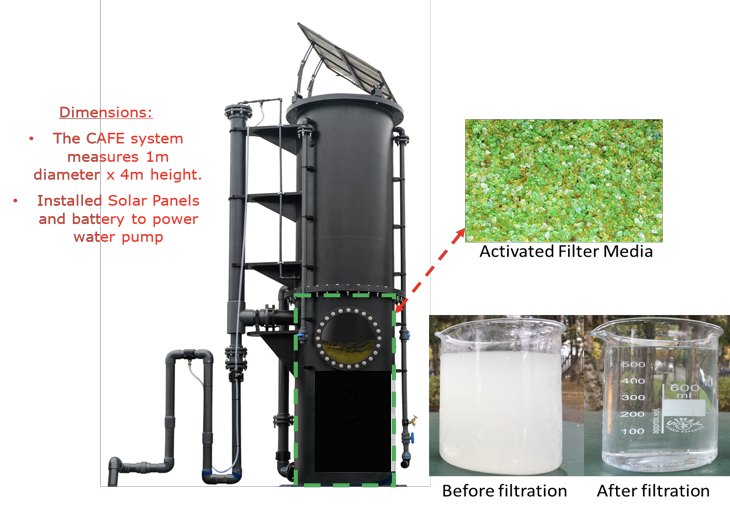
The Benefits of the CAFE system:
CAFE system is designed to be robust and has no complicated electrical panels of moving parts.
The system does not require the use of chemicals, it is chemicals free and requires almost no external energy to power its pumps.
The CAFE system uses a 12v solar-powered pump. The system comes with its own installed solar panels and battery to power its pump.
The CAFE system is therefore easily maintained with minimum technical know-how.
The CAFE system below can filter upto 2m3 per hour of water, that is up to 2000 liters of water filtered every hour. So, in 24 hours, 48,000 liters of water will be filtered. This is enough water to sustain 960 individuals consuming an average of 50 liters of water per person a day.
The Activated Filter Media (AFMTM) used in the system has a lifetime value of 25 years plus without needing to be replaced, as the media does NOT grow bacteria, unlike filtration media that uses sand. This means there is no biofouling in the system.
The CAFE system has an automated backwash process that cleans the system and the filter media, to ensure fresh drinking water is supplied constantly.
Deployment Strategy For Nigeria:
Nigeria is a country rich in water resources with surface water found in nearly every part of the country, with water stored in the ground as well. Nigeria has 215 cubic kilometres a year of available surface water, a lot higher than neighbouring countries. With this one will imagine that there is plenty available drinking water, but this is not the case. Only 19% of Nigeria’s population have access to safe drinking water.
The lack of accessible, reliable and safe drinking water coupled with poor sanitation and hygiene is estimated to cost Nigeria about USD 1.3 billion in access time, loss of lives due to premature death, productive time lost and high health care costs.
GGL is looking to deploy the CAFE system in Nigeria to provide good portable drinking water in rural areas and urban areas with contaminated surface water.
